Description
Given the root of a binary tree, the depth of each node is the shortest distance to the root.
Return the smallest subtree such that it contains all the deepest nodes in the original tree.
A node is called the deepest if it has the largest depth possible among any node in the entire tree.
The subtree of a node is a tree consisting of that node, plus the set of all descendants of that node.
Example 1:
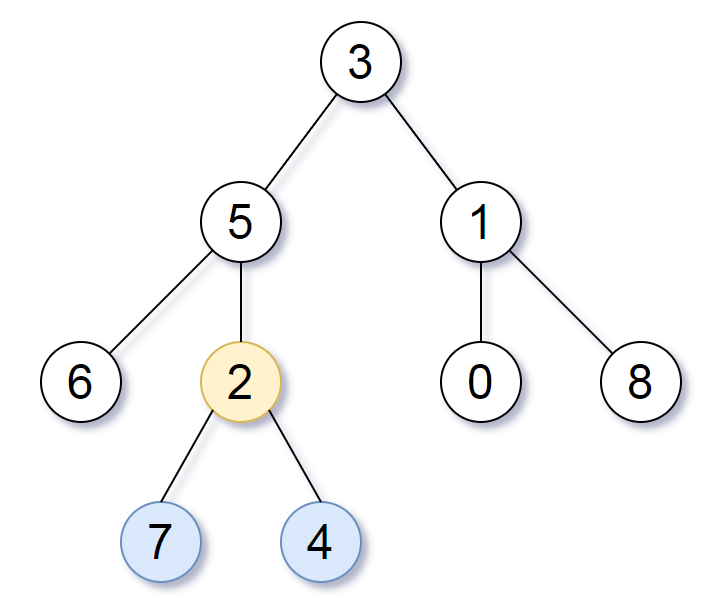
Input: root = [3,5,1,6,2,0,8,null,null,7,4] Output: [2,7,4] Explanation: We return the node with value 2, colored in yellow in the diagram. The nodes coloured in blue are the deepest nodes of the tree. Notice that nodes 5, 3 and 2 contain the deepest nodes in the tree but node 2 is the smallest subtree among them, so we return it.
Example 2:
Input: root = [1] Output: [1] Explanation: The root is the deepest node in the tree.
Example 3:
Input: root = [0,1,3,null,2] Output: [2] Explanation: The deepest node in the tree is 2, the valid subtrees are the subtrees of nodes 2, 1 and 0 but the subtree of node 2 is the smallest.
Constraints:
- The number of nodes in the tree will be in the range
[1, 500]. 0 <= Node.val <= 500- The values of the nodes in the tree are unique.
Note: This question is the same as 1123: https://leetcode.com/problems/lowest-common-ancestor-of-deepest-leaves/
Solutions
This solution uses a single depth-first search to find the smallest subtree containing all the deepest nodes of a binary tree. The recursive dfs function walks the tree while tracking each node's depth, updating a shared height variable so it always holds the maximum depth seen so far; when it steps past a leaf (!node), it returns depth - 1, the depth of the last real node on that path. After recursing, each node learns leftDepth and rightDepth — the deepest levels reachable through its left and right subtrees — and if both equal the overall height, that node has deepest nodes on both sides (or is itself a deepest leaf), so it becomes the candidate maxNode. Because the check runs bottom-up as the recursion unwinds toward the root, the last node to satisfy it is the lowest common ancestor of all the deepest nodes, which is returned as the answer in a single O(n) pass.
/**
* Definition for a binary tree node.
* function TreeNode(val, left, right) {
* this.val = (val===undefined ? 0 : val)
* this.left = (left===undefined ? null : left)
* this.right = (right===undefined ? null : right)
* }
*/
/**
* @param {TreeNode} root
* @return {TreeNode}
*/
var subtreeWithAllDeepest = function (root) {
let height = 0;
let maxNode = null;
const dfs = (node, depth) => {
if (!node) return depth - 1;
height = Math.max(height, depth);
const leftDepth = dfs(node.left, depth + 1);
const rightDepth = dfs(node.right, depth + 1);
if (leftDepth === height && rightDepth === height) {
maxNode = node;
}
return Math.max(leftDepth, rightDepth);
};
dfs(root, 0);
return maxNode;
};