Description
On a 2D plane, there are n points with integer coordinates points[i] = [xi, yi]. Return the minimum time in seconds to visit all the points in the order given by points.
You can move according to these rules:
- In
1second, you can either:- move vertically by one unit,
- move horizontally by one unit, or
- move diagonally
sqrt(2)units (in other words, move one unit vertically then one unit horizontally in1second).
- You have to visit the points in the same order as they appear in the array.
- You are allowed to pass through points that appear later in the order, but these do not count as visits.
Example 1:
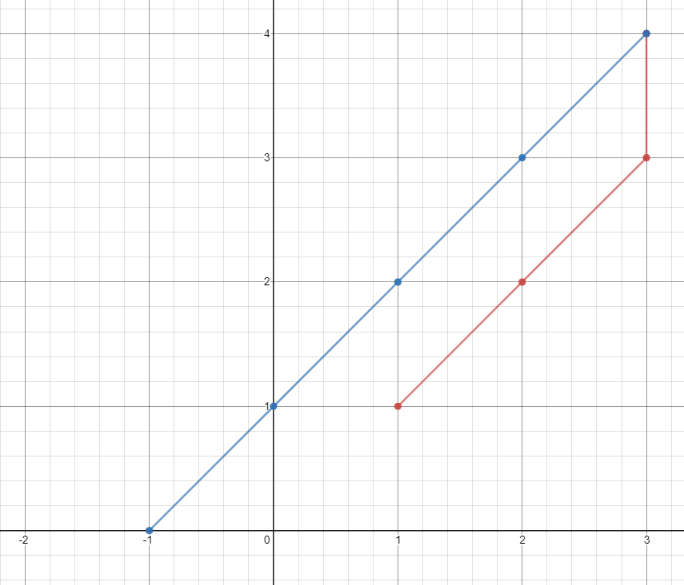
Input: points = [[1,1],[3,4],[-1,0]]
Output: 7
Explanation: One optimal path is [1,1] -> [2,2] -> [3,3] -> [3,4] -> [2,3] -> [1,2] -> [0,1] -> [-1,0]
Time from [1,1] to [3,4] = 3 seconds
Time from [3,4] to [-1,0] = 4 seconds
Total time = 7 seconds
Example 2:
Input: points = [[3,2],[-2,2]]
Output: 5
Constraints:
points.length == n1 <= n <= 100points[i].length == 2-1000 <= points[i][0], points[i][1] <= 1000