Description
You are given the root of a binary tree where each node has a value 0 or 1. Each root-to-leaf path represents a binary number starting with the most significant bit.
- For example, if the path is
0 -> 1 -> 1 -> 0 -> 1, then this could represent01101in binary, which is13.
For all leaves in the tree, consider the numbers represented by the path from the root to that leaf. Return the sum of these numbers.
The test cases are generated so that the answer fits in a 32-bits integer.
Example 1:
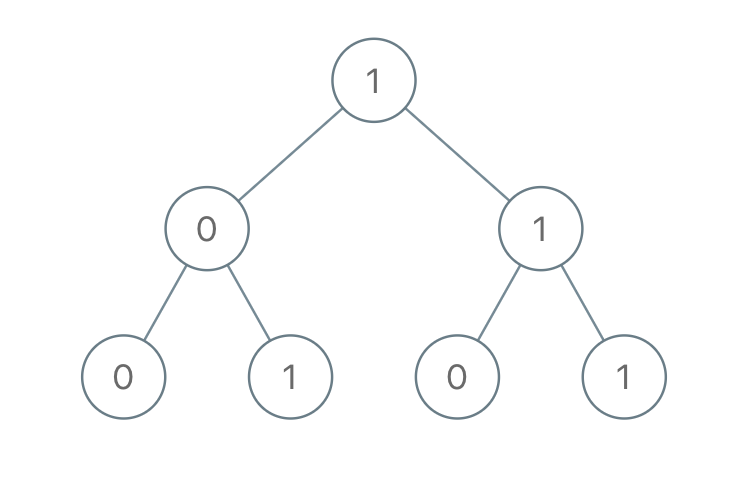
Input: root = [1,0,1,0,1,0,1] Output: 22 Explanation: (100) + (101) + (110) + (111) = 4 + 5 + 6 + 7 = 22
Example 2:
Input: root = [0] Output: 0
Constraints:
- The number of nodes in the tree is in the range
[1, 1000]. Node.valis0or1.
Solutions
This refactored version accomplishes the same goal but with cleaner code by making the DFS function return the sum directly instead of mutating an external variable. As it traverses the binary tree with DFS, it builds up the binary string representation of each path and, upon reaching a leaf node, converts it to decimal using parseInt(cur, 2) and returns it. For non-leaf nodes, it returns the combined sum of both subtrees using dfs(node.left, cur) + dfs(node.right, cur), eliminating the need for an external accumulator.
/**
* Definition for a binary tree node.
* function TreeNode(val, left, right) {
* this.val = (val===undefined ? 0 : val)
* this.left = (left===undefined ? null : left)
* this.right = (right===undefined ? null : right)
* }
*/
/**
* @param {TreeNode} root
* @return {number}
*/
var sumRootToLeaf = function(root) {
return dfs(root, '');
};
const dfs = (node, cur) => {
if (!node) {
return 0;
}
cur += node.val;
if (!node.left && !node.right) {
return parseInt(cur, 2);
}
return dfs(node.left, cur) + dfs(node.right, cur);
};