Description
Given an n x n binary grid, in one step you can choose two adjacent rows of the grid and swap them.
A grid is said to be valid if all the cells above the main diagonal are zeros.
Return the minimum number of steps needed to make the grid valid, or -1 if the grid cannot be valid.
The main diagonal of a grid is the diagonal that starts at cell (1, 1) and ends at cell (n, n).
Example 1:

Input: grid = [[0,0,1],[1,1,0],[1,0,0]] Output: 3
Example 2:
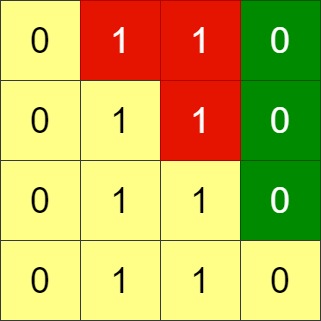
Input: grid = [[0,1,1,0],[0,1,1,0],[0,1,1,0],[0,1,1,0]] Output: -1 Explanation: All rows are similar, swaps have no effect on the grid.
Example 3:
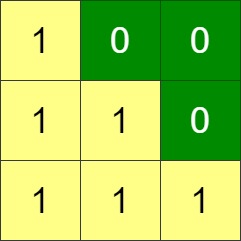
Input: grid = [[1,0,0],[1,1,0],[1,1,1]] Output: 0
Constraints:
n == grid.length== grid[i].length1 <= n <= 200grid[i][j]is either0or1
Solutions
This function computes the minimum number of adjacent row swaps required to transform a binary grid into a valid arrangement where each row i has its rightmost 1 at position i or earlier. It starts by recording the column position of each row's rightmost 1 in a pos array, then iterates through each row index from left to right. For each position, it searches for an unvisited row with a rightmost 1 at or before the target column, increments the swap count by the distance needed, and rearranges the pos array using adjacent swaps. If no suitable row exists for any position, it returns -1 (indicating an impossible configuration).
/**
* @param {number[][]} grid
* @return {number}
*/
var minSwaps = function (grid) {
const n = grid.length;
const pos = new Array(n).fill(-1);
for (let i = 0; i < n; i++) {
for (let j = n - 1; j >= 0; j--) {
if (grid[i][j] === 1) {
pos[i] = j;
break;
}
}
}
let ans = 0;
for (let i = 0; i < n; i++) {
let k = -1;
for (let j = i; j < n; j++) {
if (pos[j] <= i) {
ans += j - i;
k = j;
break;
}
}
if (k === -1) {
return -1;
}
for (let j = k; j > i; j--) {
const temp = pos[j];
pos[j] = pos[j - 1];
pos[j - 1] = temp;
}
}
return ans;
};