Description
You are given an m x n integer matrix mat and an integer k. The matrix rows are 0-indexed.
The following process happens k times:
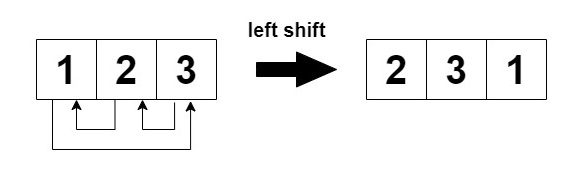
- Even-indexed rows (0, 2, 4, ...) are cyclically shifted to the left.
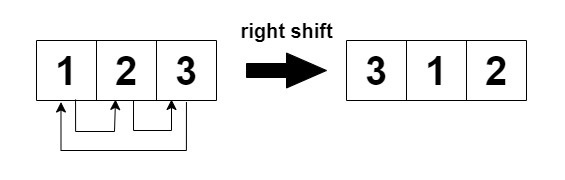
- Odd-indexed rows (1, 3, 5, ...) are cyclically shifted to the right.
Return true if the final modified matrix after k steps is identical to the original matrix, and false otherwise.
Example 1:
Input: mat = [[1,2,3],[4,5,6],[7,8,9]], k = 4
Output: false
Explanation:
In each step left shift is applied to rows 0 and 2 (even indices), and right shift to row 1 (odd index).

Example 2:
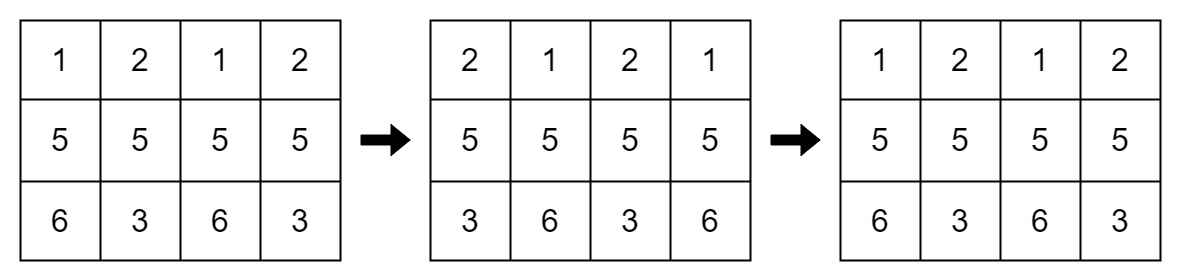
Input: mat = [[1,2,1,2],[5,5,5,5],[6,3,6,3]], k = 2
Output: true
Explanation:
Example 3:
Input: mat = [[2,2],[2,2]], k = 3
Output: true
Explanation:
As all the values are equal in the matrix, even after performing cyclic shifts the matrix will remain the same.
Constraints:
1 <= mat.length <= 251 <= mat[i].length <= 251 <= mat[i][j] <= 251 <= k <= 50
Solutions
This solution checks matrix similarity after k cyclic rotations using a cleaner approach with explicit variable names. It calculates mv as the effective column shift (k modulo column count), then for each matrix element, it determines the new column position after rotation by applying either a positive or negative shift depending on column parity (odd columns shift one way, even columns the opposite way). The modulo operation with n ensures the new column index wraps around. If all elements match their expected positions after rotation, the function returns true; otherwise false.
/**
* @param {number[][]} mat
* @param {number} k
* @return {boolean}
*/
var areSimilar = function(mat, k) {
const m = mat.length;
const n = mat[0].length;
const mv = k % n;
for (let row = 0; row < m; row++) {
for (let col = 0; col < n; col++) {
const shift = col & 1 ? mv : -mv;
const nc = (col + shift + n) % n;
if (mat[row][nc] !== mat[row][col]) {
return false;
}
}
}
return true;
};