Description
There is an undirected tree with n nodes labeled from 1 to n, rooted at node 1. The tree is represented by a 2D integer array edges of length n - 1, where edges[i] = [ui, vi] indicates that there is an edge between nodes ui and vi.
Initially, all edges have a weight of 0. You must assign each edge a weight of either 1 or 2.
The cost of a path between any two nodes u and v is the total weight of all edges in the path connecting them.
Select any one node x at the maximum depth. Return the number of ways to assign edge weights in the path from node 1 to x such that its total cost is odd.
Since the answer may be large, return it modulo 109 + 7.
Note: Ignore all edges not in the path from node 1 to x.
Example 1:
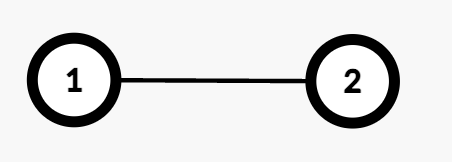
Input: edges = [[1,2]]
Output: 1
Explanation:
- The path from Node 1 to Node 2 consists of one edge (
1 → 2). - Assigning weight 1 makes the cost odd, while 2 makes it even. Thus, the number of valid assignments is 1.
Example 2:
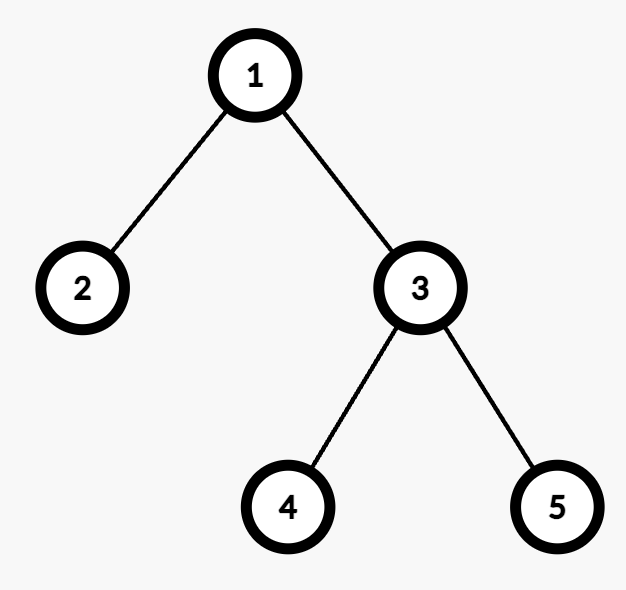
Input: edges = [[1,2],[1,3],[3,4],[3,5]]
Output: 2
Explanation:
- The maximum depth is 2, with nodes 4 and 5 at the same depth. Either node can be selected for processing.
- For example, the path from Node 1 to Node 4 consists of two edges (
1 → 3and3 → 4). - Assigning weights (1,2) or (2,1) results in an odd cost. Thus, the number of valid assignments is 2.
Constraints:
2 <= n <= 105edges.length == n - 1edges[i] == [ui, vi]1 <= ui, vi <= nedgesrepresents a valid tree.