Description
You want to build n new buildings in a city. The new buildings will be built in a line and are labeled from 1 to n.
However, there are city restrictions on the heights of the new buildings:
- The height of each building must be a non-negative integer.
- The height of the first building must be
0. - The height difference between any two adjacent buildings cannot exceed
1.
Additionally, there are city restrictions on the maximum height of specific buildings. These restrictions are given as a 2D integer array restrictions where restrictions[i] = [idi, maxHeighti] indicates that building idi must have a height less than or equal to maxHeighti.
It is guaranteed that each building will appear at most once in restrictions, and building 1 will not be in restrictions.
Return the maximum possible height of the tallest building.
Example 1:
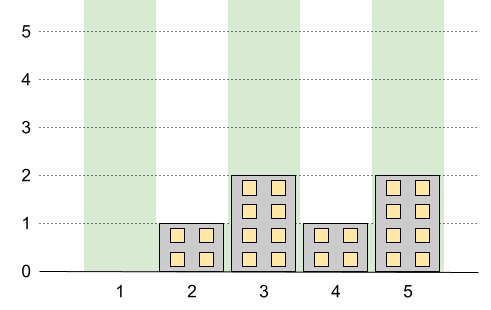
Input: n = 5, restrictions = [[2,1],[4,1]]
Output: 2
Explanation: The green area in the image indicates the maximum allowed height for each building.
We can build the buildings with heights [0,1,2,1,2], and the tallest building has a height of 2.
Example 2:
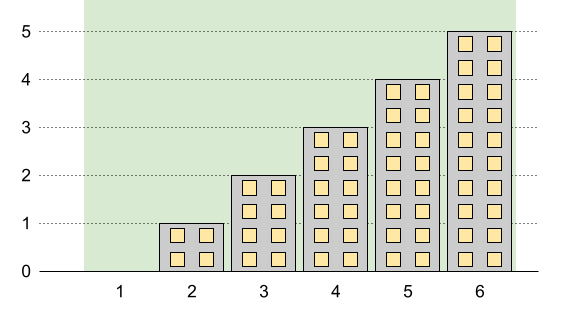
Input: n = 6, restrictions = []
Output: 5
Explanation: The green area in the image indicates the maximum allowed height for each building.
We can build the buildings with heights [0,1,2,3,4,5], and the tallest building has a height of 5.
Example 3:
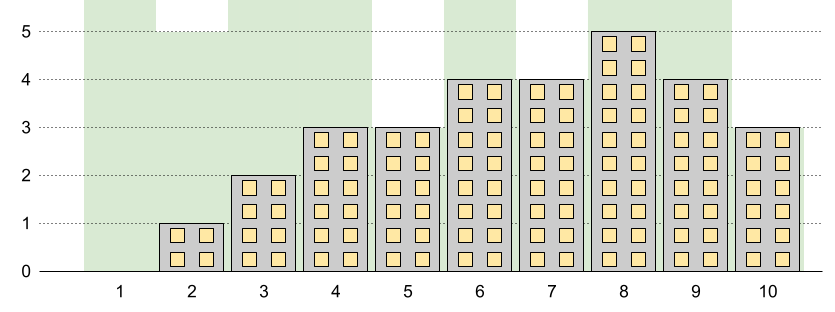
Input: n = 10, restrictions = [[5,3],[2,5],[7,4],[10,3]]
Output: 5
Explanation: The green area in the image indicates the maximum allowed height for each building.
We can build the buildings with heights [0,1,2,3,3,4,4,5,4,3], and the tallest building has a height of 5.
Constraints:
2 <= n <= 1090 <= restrictions.length <= min(n - 1, 105)2 <= idi <= nidiis unique.0 <= maxHeighti <= 109