Description
You are given two images, img1 and img2, represented as binary, square matrices of size n x n. A binary matrix has only 0s and 1s as values.
We translate one image however we choose by sliding all the 1 bits left, right, up, and/or down any number of units. We then place it on top of the other image. We can then calculate the overlap by counting the number of positions that have a 1 in both images.
Note also that a translation does not include any kind of rotation. Any 1 bits that are translated outside of the matrix borders are erased.
Return the largest possible overlap.
Example 1:
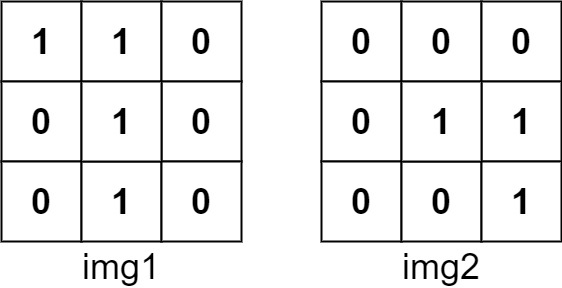
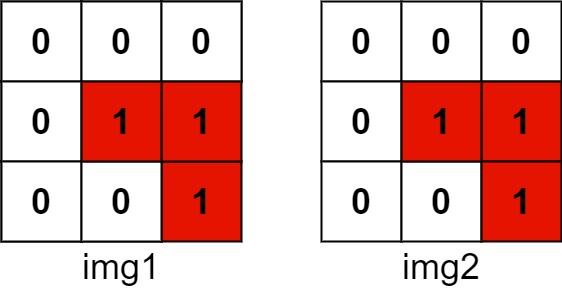
Input: img1 = [[1,1,0],[0,1,0],[0,1,0]], img2 = [[0,0,0],[0,1,1],[0,0,1]] Output: 3 Explanation: We translate img1 to right by 1 unit and down by 1 unit.The number of positions that have a 1 in both images is 3 (shown in red).
Example 2:
Input: img1 = [[1]], img2 = [[1]]
Output: 1
Example 3:
Input: img1 = [[0]], img2 = [[0]]
Output: 0
Constraints:
n == img1.length == img1[i].lengthn == img2.length == img2[i].length1 <= n <= 30img1[i][j]is either0or1.img2[i][j]is either0or1.